

Key Takeaways
- Home workouts cost less over time and remove commute as a barrier to consistency.
- Gyms provide access to specialized equipment that is difficult and expensive to replicate at home.
- Consistency, not location, determines whether a fitness routine produces results.
- Bodyweight and resistance-band training at home can build real strength for most fitness goals.
- Neither option suits every person; your schedule, household, and habits matter more than the setting.
Option A
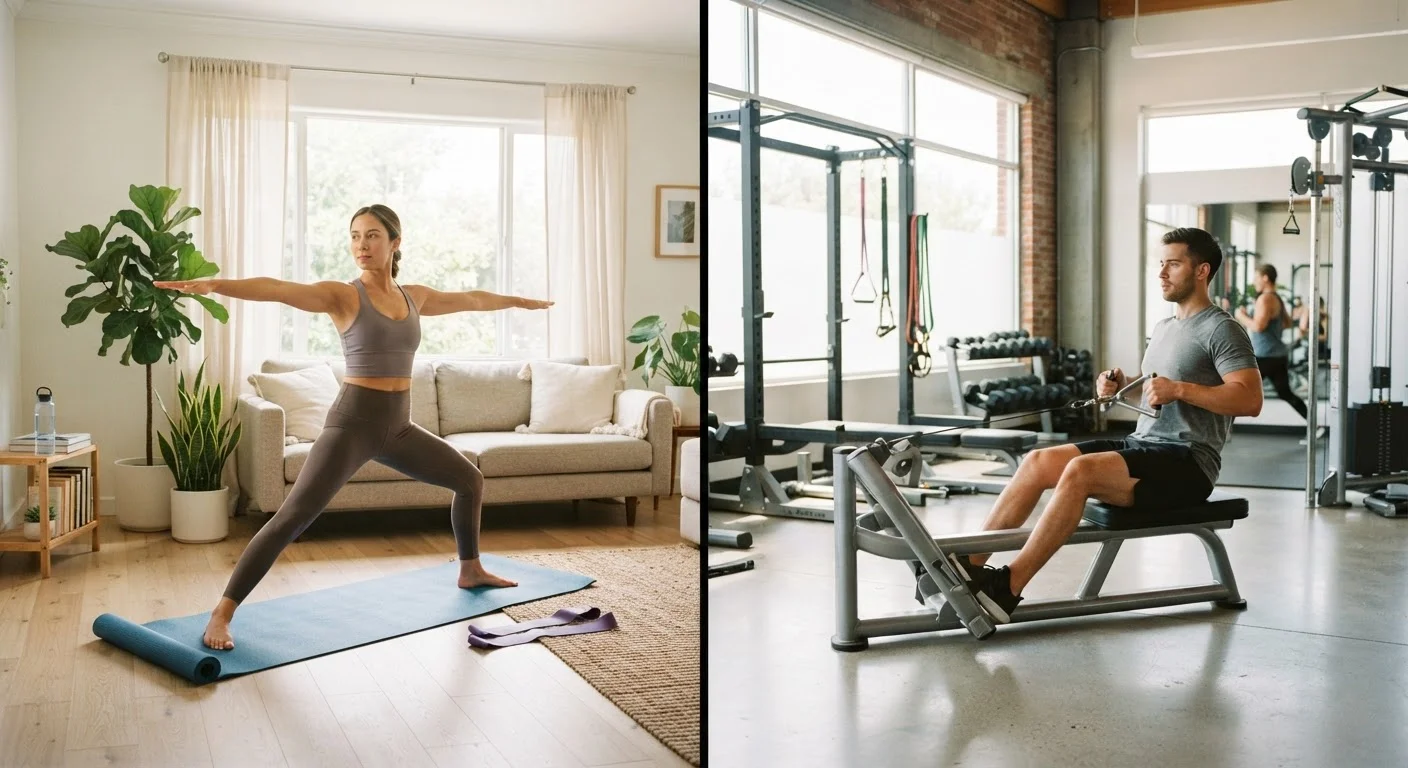
Home workouts
The flexible, zero-commute option.
Best for: People who want to train on their own schedule without a recurring membership cost.
Option B
Gym membership
The structured, equipment-rich environment.
Best for: People who benefit from dedicated space, varied equipment, and social accountability.
If your main barrier to exercise is time and commute
Home workouts
Removing travel time lowers the friction that derails most routines. A short session at home is far more useful than a gym visit that never happens.
If you are training for strength sports or need heavy barbells and specialized machines
Gym membership
Progressively heavier free weights and machines like cable stacks are impractical to own at home, and a gym gives you consistent access to them.
If you are on a tight budget and building a general fitness base
Home workouts
Bodyweight movements cover most of what a beginner needs, and free video resources mean you do not have to pay for instruction.
If you struggle to stay motivated without social structure or guidance
Gym membership
Group classes, fitness staff, and the social atmosphere of a gym can provide the external accountability that keeps some people consistent.
If you have a family and limited private time at home
Gym membership
A gym offers a defined space away from household distractions, which some parents find is the only way to complete a workout without interruption.
What you actually get in each setting
Home workouts require almost no financial commitment to start. A clear floor, comfortable clothing, and free video instruction from public platforms or library apps cover most of what a beginner needs. Resistance bands and a jump rope add variety for a modest one-time cost. The tradeoff is a ceiling: without heavy weights or cable machines, advanced strength progressions become harder to achieve over time.
A gym gives you access to a wide range of equipment in a single location. Barbells, cable stacks, rowing machines, and swimming pools are examples of tools that cost thousands of dollars to own privately and require significant space. You also gain access to fitness staff who can answer form questions, which matters for exercises where technique affects safety. The recurring cost, however, is real. Average gym membership fees in the United States range from roughly $30 to $60 per month for standard facilities, according to data compiled by the International Health, Racquet and Sportsclub Association.
For families watching a budget, that annual expense is worth examining carefully before committing. Free fitness resources can substitute for much of what a gym provides at the beginner and intermediate level.
| Criterion | Home workouts | Gym membership |
|---|---|---|
| Upfront cost | Minimal to none | Enrollment fee plus monthly dues |
| Ongoing cost | None or low (optional gear) | $30 to $60+ per month (typical) |
| Equipment variety | Limited without investment | Wide range available |
| Commute required | None | Yes, travel time each session |
| Schedule flexibility | Fully flexible | Subject to hours and availability |
| Privacy | High (your own space) | Shared environment |
| Social accountability | Low (self-directed) | Higher (classes, staff, community) |
| Suitability for heavy lifting | Limited without significant gear | Strong (barbells, racks available) |
The consistency question
Exercise science is consistent on one point: the training you actually do produces results, and the training you skip does not. Location is secondary to habit. A gym membership that goes unused three weeks out of four will not improve your health, and a home routine practiced five days a week will.
Home workouts remove commute as a barrier. For a parent with a tight schedule, the ability to start a 20-minute session the moment the kids are asleep changes what is realistic. Fitting workouts into a packed schedule is easier when the workout space is already there.
Gyms create a different kind of consistency for some people. The act of traveling to a dedicated facility signals that exercise is the only task at hand. Some people find that the separation from home reduces the pull of competing demands. Group fitness classes also introduce a social commitment: showing up because others expect you there is a legitimate motivational tool.
Neither environment is inherently more motivating. The question is which context matches how you personally maintain habits.
Space, noise, and household realities
Home workouts depend on having usable space and reasonable privacy. A one-bedroom apartment with thin walls and a toddler nearby presents real constraints that a gym does not. Jumping exercises, for example, may not be practical in an upstairs unit. Families with young children may find that home workouts require creative scheduling, since uninterrupted time at home is not guaranteed.
A gym sidesteps those logistics. Equipment is maintained by the facility, floor space is available regardless of your apartment size, and the environment is built for exercise. For families where home simply does not offer a quiet corner, a gym can be the more realistic option even if the cost is higher.
That said, families can also treat shared outdoor spaces, parks, and community recreation centers as part of their fitness infrastructure. Low-cost ways to build movement into family life outlines how to use these resources without a membership.
What the research says about workout effectiveness
A common assumption is that gym equipment produces better results than bodyweight training. The picture is more specific than that. For building cardiovascular fitness and general muscular endurance, bodyweight movements, resistance bands, and moderate-weight dumbbells perform comparably to machine-based training for most people at most fitness levels. Bodyweight training covers this in more detail, including its real limits.
Where gyms have a clear practical edge is in heavy progressive overload. Strength sports and programs designed around barbell lifts require weight that most home setups cannot safely provide. If your goal is competitive powerlifting or significant hypertrophy past an intermediate level, gym access becomes more important.
For general health, the American College of Sports Medicine recommends at least 150 minutes of moderate-intensity aerobic activity per week alongside two days of muscle-strengthening activity. Both targets are achievable at home. Common fitness misconceptions includes the belief that results require expensive equipment, which exercise research does not support for most goals.
This article is for general informational purposes only and is not a substitute for advice from a qualified healthcare or fitness professional. Consult a professional before starting a new exercise program, especially if you have an existing health condition.