

Key Takeaways
- Bodyweight training uses your own body as resistance and requires no equipment or gym membership.
- It can build real strength and cardiovascular fitness, but has limits for advanced muscle growth.
- Progression is possible through leverage, tempo, and movement complexity rather than added weight.
- It fits almost any schedule and space, making consistency easier to maintain long-term.
- People with specific health conditions should consult a healthcare professional before starting any new exercise program.
Zero cost, no equipment needed
The only requirement is floor space. There are no gym fees, no equipment purchases, and no travel time, which removes the most common barriers to starting and sticking with exercise.
Works in almost any space or schedule
A 20-minute session in a bedroom, hotel room, or backyard is enough to maintain a meaningful training stimulus. The flexibility makes it easier to stay consistent when life gets busy.
Accessible to beginners with no fitness background
Most foundational movements have easier entry-level versions: incline push-ups instead of flat, chair-assisted squats, or bent-knee planks. People can start where they are and build from there.
Builds functional strength across multiple muscle groups
Compound bodyweight movements like squats, push-ups, and rows recruit several muscle groups at once, which tends to translate well to everyday physical tasks like carrying groceries or climbing stairs.
Lower injury risk for beginners than heavy free weights
Because load is limited to body weight and movements are natural patterns, beginners face less risk of the acute injuries that can come from learning to lift heavy loads before mastering technique.
Can improve cardiovascular fitness when structured as circuits
Pairing movements with minimal rest between sets keeps the heart rate elevated, producing cardiovascular benefits alongside strength work in the same session.
Limited ceiling for building maximum muscle mass
Once you exhaust available progressions, bodyweight training cannot easily replicate the high loads that stimulate maximum hypertrophy. People targeting significant muscle growth will likely need supplemental resistance at some point.
Pull movements require at least a minimal setup
Horizontal and vertical pulling patterns, which are necessary for balanced upper-body development, require something to pull against: a low table edge, a door-frame pull-up bar, or playground equipment. They cannot be done with nothing.
Progress can stall without intentional programming
Without a plan that systematically increases difficulty, many people plateau at comfortable rep counts and stop seeing improvement. Random or intuitive training does not reliably produce progressive overload.
Not optimal for isolated muscle targeting
Bodyweight exercises are predominantly compound movements. If a person has a rehabilitation goal or wants to isolate a specific muscle for corrective or aesthetic reasons, bodyweight options may be limited.
Our Verdict
Bodyweight training is a legitimate, research-supported method for improving strength, endurance, and mobility without any cost barrier. It works well for beginners and intermediate exercisers who want a sustainable, flexible routine. Its ceiling is lower than free-weight or machine training for building maximum muscle mass, so people with advanced strength goals may eventually need additional tools.
Anyone who wants an effective, zero-cost fitness routine they can do at home, while traveling, or with their family, and who values consistency over maximum muscle hypertrophy.
What bodyweight training actually is
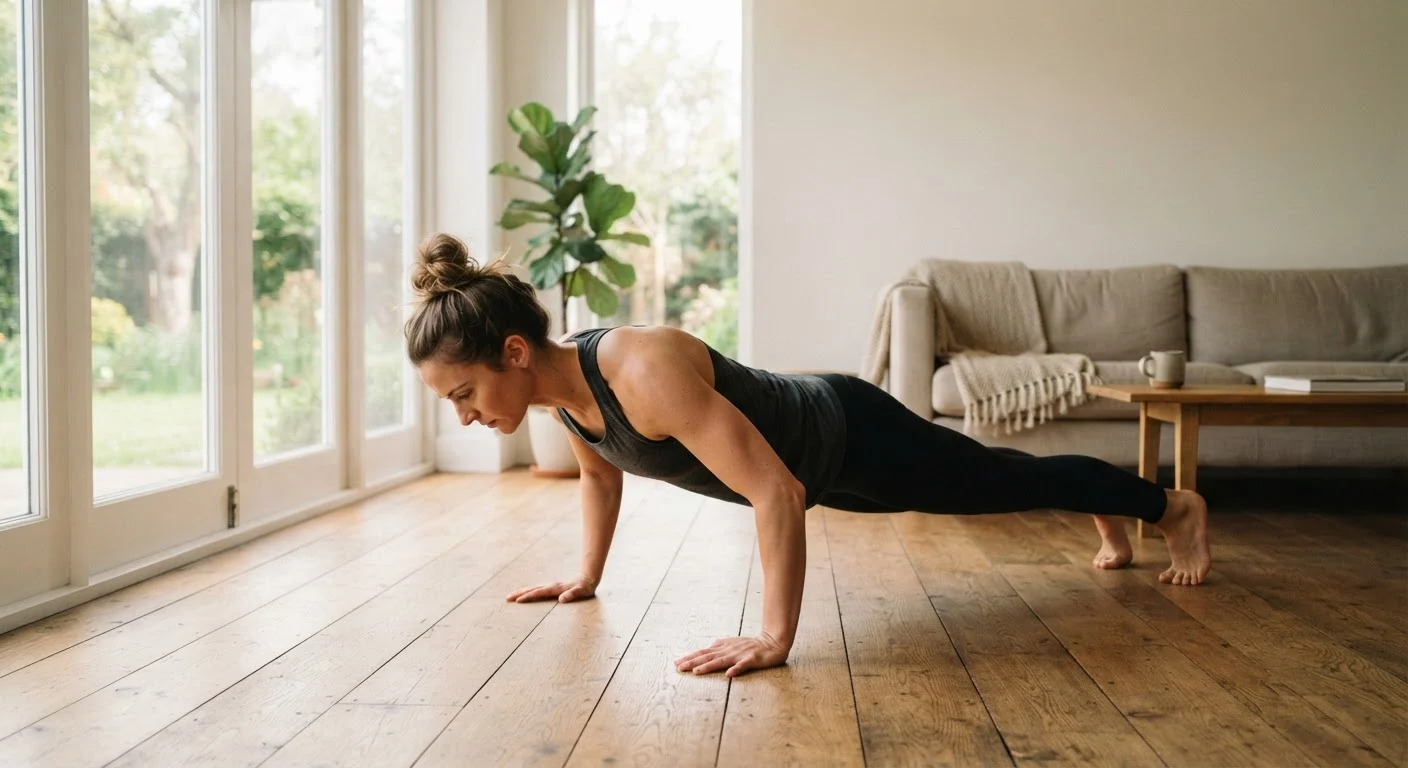
Bodyweight training is exercise that uses your own body mass as the primary source of resistance. No barbells, no machines, no gym card required. Movements like push-ups, squats, lunges, planks, and pull-ups (using a bar, door frame, or playground structure) fall into this category, as do more demanding variations like single-leg squats and pike push-ups.
The mechanics are the same as any resistance training: your muscles contract against a load to produce movement, and over time that repeated stress prompts the body to adapt by getting stronger. The difference is that the load is your own weight, and you adjust difficulty by changing the angle, tempo, range of motion, or movement pattern rather than adding plates to a bar.
Bodyweight training also overlaps with mobility work and cardiovascular conditioning, depending on how sessions are structured. A circuit of burpees and mountain climbers taxes the cardiovascular system. A slow, controlled single-leg deadlift demands balance and hip stability. This flexibility is one reason the approach suits a wide range of goals. For families looking to build movement habits together, see low-cost ways to build movement into daily life for practical ideas that pair well with bodyweight work.
What it can realistically do for you
For most people starting from a sedentary baseline, bodyweight training produces measurable gains in muscular endurance, functional strength, and cardiovascular fitness. Research in exercise physiology consistently shows that progressive resistance training, regardless of whether resistance comes from weights or body mass, stimulates muscle protein synthesis and strength adaptation when load and volume are sufficient.
Beginners typically see strength gains quickly because the early improvements come partly from neurological adaptation: the nervous system becomes more efficient at recruiting muscle fibers. That phase lasts several months and produces real, visible changes in how movement feels and looks.
Bodyweight routines also support joint health and mobility. Many movements require coordinated effort across multiple muscle groups and joints, which builds practical, transferable strength rather than isolated muscle size.
8-12 weeks
Typical timeframe for beginners to notice strength improvements
Exercise physiology research generally finds that novice trainees experience measurable strength gains within this window when following a consistent progressive resistance program.
2-3x per week
Recommended training frequency for muscle and strength adaptation
The American College of Sports Medicine recommends resistance training each major muscle group two to three times per week for general fitness and strength development in healthy adults.
However, there is a ceiling. Once a movement becomes easy and you have exhausted reasonable progressions, adding more repetitions produces endurance gains rather than strength or hypertrophy gains. Someone who can do 40 push-ups with ease is no longer applying enough stimulus for muscle growth, and standard bodyweight options may not bridge that gap without creative problem-solving or supplemental equipment.
If you want a clearer picture of what exercise science supports versus what fitness culture overstates, common fitness myths examined against the evidence is worth reading before you set expectations.
Pros and cons at a glance
Bodyweight training has genuine strengths and real limitations. The list below covers both honestly.
Zero cost, no equipment needed
The only requirement is floor space. There are no gym fees, no equipment purchases, and no travel time, which removes the most common barriers to starting and sticking with exercise.
Works in almost any space or schedule
A 20-minute session in a bedroom, hotel room, or backyard is enough to maintain a meaningful training stimulus. The flexibility makes it easier to stay consistent when life gets busy.
Accessible to beginners with no fitness background
Most foundational movements have easier entry-level versions: incline push-ups instead of flat, chair-assisted squats, or bent-knee planks. People can start where they are and build from there.
Builds functional strength across multiple muscle groups
Compound bodyweight movements like squats, push-ups, and rows recruit several muscle groups at once, which tends to translate well to everyday physical tasks like carrying groceries or climbing stairs.
Lower injury risk for beginners than heavy free weights
Because load is limited to body weight and movements are natural patterns, beginners face less risk of the acute injuries that can come from learning to lift heavy loads before mastering technique.
Can improve cardiovascular fitness when structured as circuits
Pairing movements with minimal rest between sets keeps the heart rate elevated, producing cardiovascular benefits alongside strength work in the same session.
Limited ceiling for building maximum muscle mass
Once you exhaust available progressions, bodyweight training cannot easily replicate the high loads that stimulate maximum hypertrophy. People targeting significant muscle growth will likely need supplemental resistance at some point.
Pull movements require at least a minimal setup
Horizontal and vertical pulling patterns, which are necessary for balanced upper-body development, require something to pull against: a low table edge, a door-frame pull-up bar, or playground equipment. They cannot be done with nothing.
Progress can stall without intentional programming
Without a plan that systematically increases difficulty, many people plateau at comfortable rep counts and stop seeing improvement. Random or intuitive training does not reliably produce progressive overload.
Not optimal for isolated muscle targeting
Bodyweight exercises are predominantly compound movements. If a person has a rehabilitation goal or wants to isolate a specific muscle for corrective or aesthetic reasons, bodyweight options may be limited.
How to structure sessions for lasting progress
Progress in bodyweight training depends on a principle called progressive overload: gradually increasing the demand placed on muscles over time. Without it, the body adapts and stops changing. With weights, you add load. With bodyweight, you manipulate four variables.
- Leverage: Moving a limb or your center of gravity to increase mechanical disadvantage. An incline push-up is easier than a flat push-up, which is easier than a decline push-up.
- Tempo: Slowing the lowering phase of a movement (called the eccentric phase) increases time under tension and makes a given exercise harder without changing the movement itself.
- Range of motion: A deeper squat or a wider push-up grip engages more muscle through a longer arc.
- Movement complexity: Progressing from a standard squat to a single-leg squat changes the balance demand and the effective load on each leg.
A basic weekly structure for a beginner might include two or three sessions that each cover a push pattern (push-up variation), a pull pattern (rows using a low bar or table edge), a lower body movement (squat or lunge), and a core stability exercise (plank or hollow body hold). Rest at least one day between sessions that work the same muscle groups.
For a step-by-step approach to building a full weekly schedule, building a weekly exercise routine from scratch walks through how to sequence and balance sessions across the week.
Free tools and spaces can also support consistency. Public parks, community center open-gym hours, and library fitness apps are worth exploring. Free fitness resources that actually deliver results covers no-cost options that pair well with a bodyweight routine.
This article is for general informational purposes only and is not medical advice. Consult a qualified healthcare professional before starting a new exercise program, particularly if you have an existing health condition, injury, or are returning to exercise after a long break.