

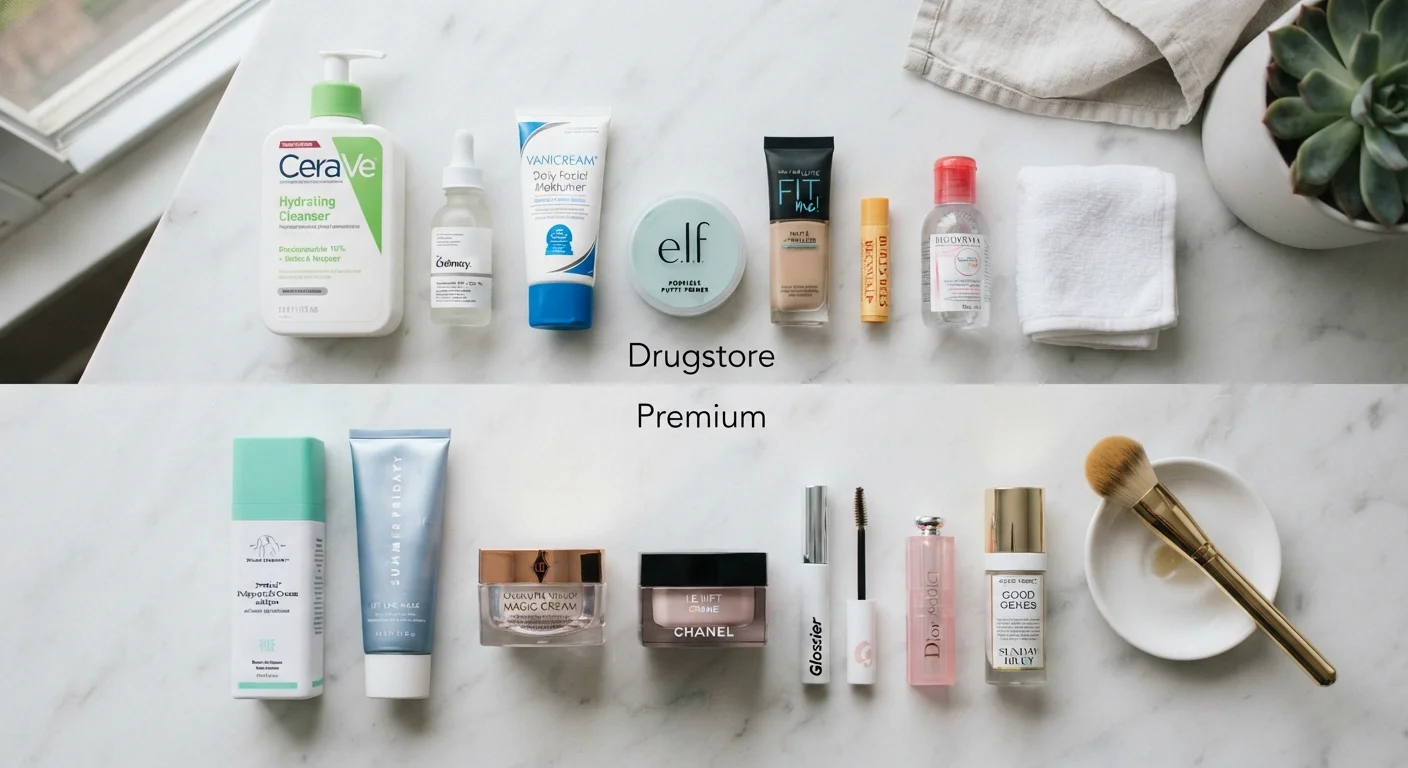
Key Takeaways
- Price does not consistently predict performance across all beauty categories.
- A few categories, such as active-ingredient skincare, show real performance differences at higher price points.
- Many categories, including basic cleansers and lip color, perform similarly regardless of price.
- Reading ingredient labels is more reliable than using price as a quality proxy.
- A mixed approach, splurging selectively and saving broadly, typically delivers the most value.
Option A
Splurge (premium beauty)
Higher-priced products with specialized formulas or ingredients.
Best for: Categories where ingredient concentration, stability, or delivery technology genuinely affects results.
Option B
Save (budget beauty)
Affordable options that often share the same core ingredients.
Best for: Categories where formula differences are minor and performance is largely comparable.
If you use retinol or prescription-strength actives in your skincare routine
Splurge (premium beauty)
Concentration, formulation stability, and delivery systems vary meaningfully at this tier. A well-formulated product can make the active ingredient more effective.
If you go through cleanser, micellar water, or makeup remover quickly
Save (budget beauty)
These products rinse off quickly, limiting contact time. Core cleansing ingredients are widely available at accessible price points.
If you color or heat-style your hair regularly
Splurge (premium beauty)
Damaged hair responds better to products with higher concentrations of conditioning agents. Some salon-grade treatments carry that extra load affordably if purchased strategically.
If you want everyday lip, eye, or nail color without a strict performance requirement
Save (budget beauty)
Pigment technology at the drugstore tier has improved considerably. For casual wear, spending more rarely produces a visible difference.
If you have sensitive skin or a diagnosed skin condition
Splurge (premium beauty)
Fragrance-free, clinically tested formulas are easier to find at premium tiers. Consult a dermatologist before selecting any product for reactive skin.
Why price alone is a poor guide
Beauty pricing reflects marketing budgets, packaging costs, and retail markups as much as it reflects what is actually inside the bottle. Two moisturizers can share nearly identical active ingredients while sitting on opposite ends of the price shelf. That does not mean price never signals quality, but it does mean the relationship is inconsistent enough that spending more is not a reliable strategy on its own.
Understanding what ingredient labels actually tell you is a more useful skill than checking the price tag. Ingredients are listed in descending order of concentration, so a budget product with a key active listed second in its formula can outperform a pricier one where that same ingredient appears near the bottom.
The goal is not to always spend less. It is to spend accurately: more in places where the difference is real, less where it is not.
Where paying more tends to deliver more
A handful of categories show a more consistent connection between price and performance.
Serums and targeted treatments. Products built around active ingredients, retinoids, vitamin C, peptides, and exfoliating acids, depend heavily on stable formulations. Higher-priced versions often carry better stabilization technology, meaning the active ingredient stays potent through the product's shelf life. Concentration matters here too: a 0.1% retinol product and a 0.3% one are not interchangeable, and that gap tends to map onto price tiers more reliably than it does in other categories.
SPF formulas. Broad-spectrum sun protection is health-adjacent, and the feel of a sunscreen affects whether people actually use it. Lightweight, skin-tone-friendly formulas that do not leave a white cast or feel greasy tend to sit at higher price points. Since consistent application drives the benefit, a formula someone will actually reach for daily is worth the extra cost for many people. This is general information; consult a dermatologist for advice specific to your skin type.
Treatments for chemically processed or heat-damaged hair. Protein and moisture-based treatments for compromised hair do show ingredient-level differences across price tiers. Maintaining healthy hair affordably is possible, but for hair that is already stressed, a well-concentrated treatment used less frequently may outperform a cheaper product used every wash.
| Criterion | Splurge (premium) | Save (budget) |
|---|---|---|
| Active ingredient concentration | Often higher and stabilized | Varies; check label position |
| Cleanser performance | Comparable to budget | Comparable to premium |
| SPF aesthetics (wearability) | More lightweight options available | Improving but fewer choices |
| Everyday makeup pigment | Similar for casual wear | Similar for casual wear |
| Fragrance-free sensitive-skin options | Wider range available | Fewer, but some exist |
| Packaging and texture experience | Generally more refined | Functional, less luxurious |
| Cost per use over time | Higher upfront, sometimes longer-lasting | Lower upfront, frequent repurchase |
Where saving makes practical sense
Many everyday products perform comparably across price tiers because their job is straightforward and the chemistry is well understood.
Cleansers. A face wash sits on skin for seconds before rinsing off. The core job, removing makeup, oil, and debris, does not require expensive actives. Drugstore cleansers and their premium counterparts routinely share the same surfactant base. Starting a simple, affordable routine at the cleansing step is one of the lowest-risk budget moves in the entire routine.
Mascara and lip color. Pigment technology at the mass-market tier has improved steadily. For everyday wear, most people cannot detect a visible difference between a drugstore mascara and a department-store version. Longevity formulas do vary, but for casual use the gap rarely justifies a large price difference.
Petroleum-based and occlusive moisturizers. Simple occlusives, products that form a barrier to seal in moisture, use inexpensive ingredients that do not improve with price. Spending more in this category typically pays for fragrance, packaging, or brand positioning rather than a different result on skin.
Common beauty spending habits that quietly drain budgets often involve buying premium versions of products in exactly these low-differentiation categories.
~60%
Shoppers who buy beauty products at mass-market retailers
Statista consumer survey data indicates the majority of US beauty shoppers make purchases at mass-market or drug stores rather than prestige channels.
Top 5
Ingredient list position matters for actives
Cosmetic chemists generally note that an active ingredient needs to appear within the first five positions on a label to be present in a meaningful concentration.
30+ seconds
Minimum SPF contact time needed for protection
Dermatology guidance indicates sunscreen must be applied and allowed to absorb before sun exposure; formula wearability directly affects consistent use.
Building a mixed routine that works
A practical approach is to treat each product category as its own decision rather than applying one rule to the whole routine. Start with your targeted treatments and SPF, where the case for spending more is stronger, then use budget options for the steps where ingredient differences are small.
Ingredient labels, shelf life, and skin response over time are better feedback signals than price. If a product is not producing results after consistent use over several weeks, the issue may be the formulation, not the price tier. Switching up or down within a category based on that feedback is reasonable.
For families managing a shared beauty budget, pooling spending toward the few categories that reward it and using accessible options everywhere else can stretch dollars without sacrificing results. Recognizing the spending patterns that quietly cost more is a useful companion step to any product audit.