

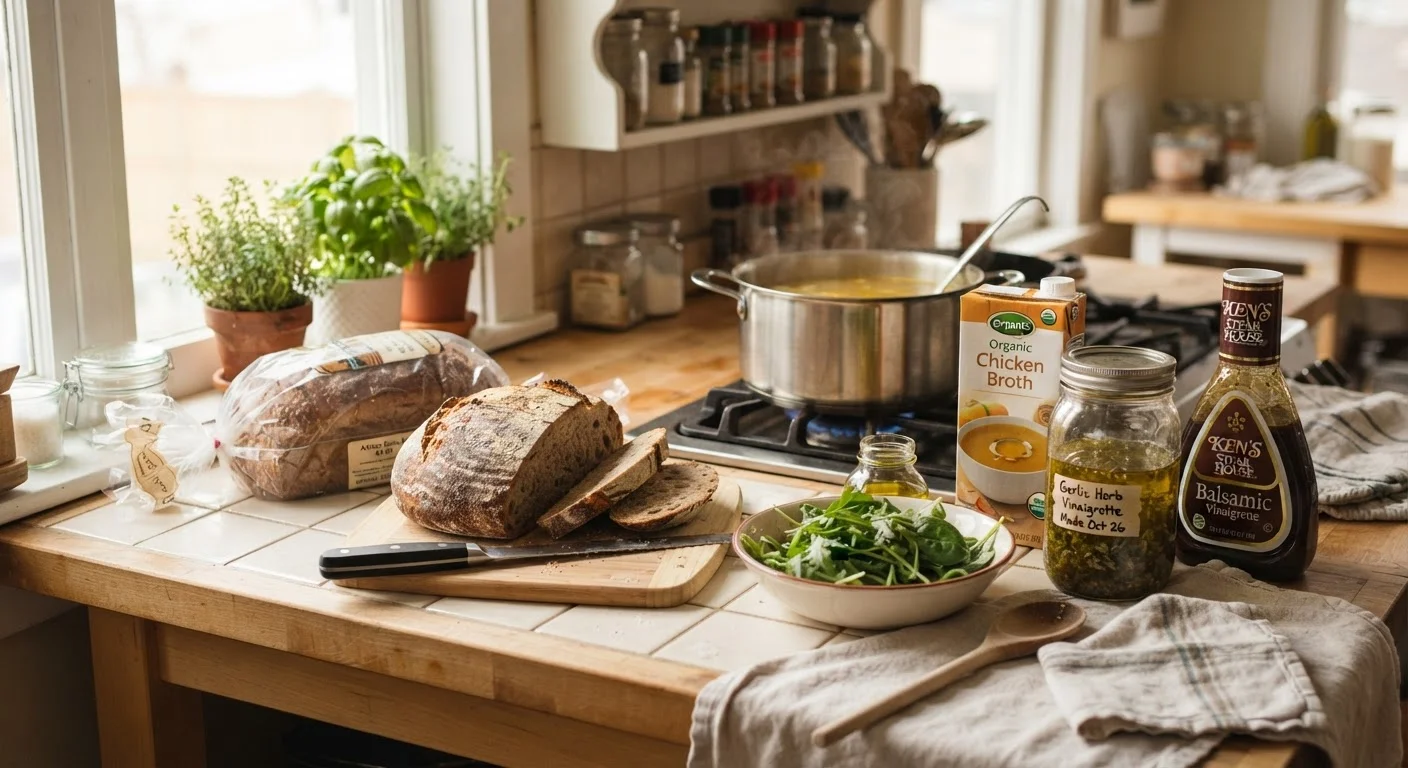
Key Takeaways
- Homemade broth and salad dressing consistently cost less than store-bought versions when made from scraps or pantry staples.
- Bread and yogurt can save money at home, but only if your household eats them fast enough to avoid waste.
- Some staples, like store-brand canned tomatoes, are rarely worth the effort to replicate at home.
- Time cost is real: factor in active prep minutes, not just ingredient prices, before committing to a DIY habit.
- A handful of staples made from scratch can meaningfully lower a weekly grocery bill over time.
Our Verdict
Homemade wins clearly for broth, salad dressing, and spice blends, where the cost difference is large and the effort is low. For bread and yogurt, the savings are real but depend on consistent consumption. Store-bought makes more practical sense for staples where the price gap is small and the time investment is significant.
| Best for | Recommended |
|---|---|
| Families wanting the biggest savings with minimal effort | Homemade broth and salad dressing |
| Households that bake regularly and consume bread quickly | Homemade sandwich bread |
| Busy families with limited weeknight prep time | Store-bought canned tomatoes and dry pasta |
| Families tracking ingredient quality and sodium intake | Homemade spice blends and broth |
The real calculation behind making it yourself
The homemade-vs-store-bought question is not purely about ingredients. It involves three variables: ingredient cost, active prep time, and whether your household will actually use what you make before it goes bad. Ignore any one of those and the math breaks down.
Store prices vary by region and store format, so treat any figures here as general guidance rather than fixed numbers. The comparisons below are based on commonly available mid-range grocery pricing and standard household quantities.
For a related look at how price does not always predict value, see why expensive does not always mean better. The same logic applies to food staples.
Staples where homemade clearly wins
Chicken or vegetable broth is the strongest case for making it yourself. A carcass or vegetable scraps that would otherwise go in the trash, simmered with water for an hour, produces several quarts of broth at close to zero marginal cost. Store-bought broth runs roughly $3 to $5 per quart. Freezing homemade broth in 1-cup portions makes it as convenient as reaching for a carton.
Salad dressing is another clear win. A basic vinaigrette made from olive oil, vinegar, mustard, and salt costs a fraction of a bottled equivalent per serving and takes under two minutes to make. Bottled dressings also typically contain stabilizers and added sugar that a homemade version avoids without any extra effort.
Spice blends, such as taco seasoning, Italian seasoning, or chili powder mix, cost far less when assembled from individual spices you already keep on hand. Pre-mixed packets charge a premium for convenience that takes about 60 seconds to replicate yourself.
| Staple | Homemade cost | Store-bought cost | Time required | Verdict | |
|---|---|---|---|---|---|
| Broth (per quart) | Near zero (scraps) | $3-$5 per quart | 1 hr mostly passive | Make it | |
| Salad dressing | $0.10-$0.20 per serving | $0.30-$0.60 per serving | Under 2 minutes | Make it | |
| Spice blends | Pennies per batch | $1-$2 per packet | Under 1 minute | Make it | |
| Sandwich bread (per loaf) | $0.50-$0.80 | $3-$5 | 20 min active, 2 hrs total | Make it if consistent | |
| Yogurt (per quart) | $1-$2 | $3-$5 | 10 min active, 8 hrs total | Make it if habitual | |
| Canned tomatoes | Higher (fresh produce) | $1-$2 per can | 30+ minutes | Buy it | |
| Dry pasta | Similar cost, more effort | $1-$2 per lb | Significant skill/time | Buy it |
Staples where the answer depends on your household
Sandwich bread can save a family money, but the savings only materialize if the loaf gets eaten within three to four days or goes into the freezer promptly. A basic white or whole-wheat sandwich loaf made at home costs roughly $0.50 to $0.80 in ingredients, compared to $3 to $5 for a store-bought equivalent. The problem: homemade bread has no preservatives, so a loaf that goes stale or moldy before it is finished erases the savings entirely. Families that bake one loaf per week and consume it consistently come out ahead. Occasional bakers often do not.
Yogurt follows similar logic. A half-gallon of plain yogurt made from a gallon of whole milk costs less per ounce than most store brands, and the process is largely hands-off. But it requires a consistent weekly habit and someone in the household who will actually eat plain yogurt. If you buy flavored single-serve cups because that is what your family prefers, homemade plain yogurt is not a realistic swap.
See dried beans vs. canned beans for a comparable case where habit and schedule determine which option is actually cheaper.
Staples where store-bought usually makes more sense
Canned tomatoes are processed at peak ripeness on commercial lines and priced at $1 to $2 per can. Replicating that at home, outside of peak tomato season when you have a garden surplus, costs more in both produce and labor. Store-brand canned tomatoes are one of the genuine value items in any grocery store, and there is no meaningful quality argument for making your own unless you are canning a summer harvest.
Dry pasta is another category where the store wins. The ingredient cost difference between homemade and store-bought dry pasta is negligible, and dry pasta requires specialized equipment or significant practice to produce at consistent quality. Fresh pasta is a different product and a different discussion, but as a direct substitute for dry pasta in weeknight cooking, homemade is not a cost-effective swap.
Condiments with long ingredient lists, such as hot sauce, soy sauce, or Worcestershire, involve fermentation, long reduction times, or hard-to-source ingredients. The savings, if any, are small. Buying these in larger sizes at a warehouse store is typically more practical than making them from scratch.
Building a realistic homemade habit
The families who save the most from homemade staples are not trying to make everything themselves. They pick two or three items that fit their cooking routine and make those consistently. Broth from a freezer bag of scraps, a jar of vinaigrette shaken before dinner, and a weekly loaf of bread can reduce a grocery bill without adding meaningful time to a week.
Starting with broth makes sense for almost any household that cooks proteins at home. The cost savings are immediate, the technique requires no skill, and it removes the need to buy broth at all. From there, look at what your family buys most frequently and ask whether the store price genuinely reflects convenience you need, or whether a five-minute homemade version would serve just as well.
Seasonal produce planning pairs well with a homemade staple habit: when you buy vegetables in bulk at seasonal prices, the trimmings and extras go into broth rather than the trash.